Device to device
Two permitted peers exchange encrypted traffic without sending it through a central VPN concentrator.

Connections & relays
Your devices prefer a direct encrypted connection. When a firewall or network prevents that, a relay can carry the same encrypted traffic.
Where the traffic goes
The controller coordinates identity, policies and connection information. It is not normally the application data path. Permitted devices connect to each other directly where possible; a relay is the fallback.
Two permitted peers exchange encrypted traffic without sending it through a central VPN concentrator.
Both devices reach a relay when a direct path is unavailable. Their traffic remains encrypted end to end.
Enrollment is not permission to reach everyone. Your company’s access policies determine which connections are allowed.
Relay deployment locations
Choose locations near your users, offices and services. Multiple regional relay addresses can provide more paths to try when a connection cannot go direct.
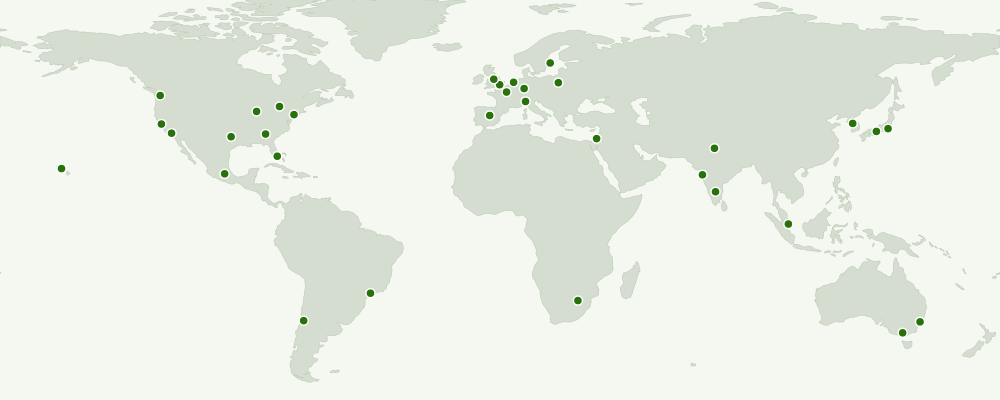
Map outline: Natural Earth, public domain. Markers show approximate city or metro centers. New Jersey represents the New York metropolitan area; Silicon Valley is a metro area.
More regions, a clear purpose
Separate regional relay addresses give clients alternatives when a relay is unreachable. Selection and recovery depend on the client, network and configured addresses; they are not a seamless-failover guarantee.
Direct traffic uses the devices’ own connections. Relayed traffic also uses relay capacity and hosting transfer. We scope location and capacity around the expected workload.
A customer-owned gateway can route configured internet traffic or reach a local network. It needs separate routing and filtering policies. A relay does not automatically provide those functions.
A little more detail
It tries the relay addresses offered to it in parallel, up to seven at a time, and keeps the first successful connection. Handshake time can reflect distance, network conditions and server load. It is a practical reachability race, not a guarantee of the lowest latency or fastest end-to-end transfer.
A working home-relay connection is retained. The pinned client does not continuously benchmark every region or move an established connection just because another relay might be faster. On failure, it first tries its previous relay when still available, then selects again with retry backoff.
They agree on one common relay for their connection using a deterministic peer rule. One device can connect to the other device’s selected relay. The path is not device → Seattle relay → Atlanta relay → device. “Home relay” describes a device’s maintained relay connection, not a requirement to use two relays for every conversation.
No. Relay location and transport are separate choices. In the pinned client’s default automatic mode, QUIC and WebSocket connection attempts race. Network restrictions and transport settings can affect which succeeds.
The relay forwards the encrypted peer traffic; it does not decrypt the WireGuard tunnel or become a content filter. An exit gateway is a separately configured device that routes selected internet traffic. Firewall or DNS filtering needs its own configuration. Relay operators can still observe connection metadata and traffic volume.
No. Relays provide additional data-path options. Controller availability, backups and disaster recovery are separate designs and service options. Adding relays does not make the controller redundant, and a relay outage is not the same as a controller outage.
No. These are locations where a relay deployment can be requested. VPNnet is in controlled Alpha. We confirm regional capacity, service availability, configuration and evaluation scope before deployment. The map is not a live-status or coverage map, and no relay is created by visiting this page.
Selection details describe the pinned NetBird 0.81.4 client used for this Alpha. Actual deployed versions and network conditions must be checked for each evaluation.
Start with your locations
Tell us where your users and resources are. We will discuss direct connections, relay options and a practical early-access evaluation.